Who Is Numa, the Third-Gender Candidate from Morang–4 ?

Dipesh Shrestha,Kathmandu.
Numa realized that the absence of the sexual and gender minority community in mainstream politics itself was a major weakness. This realization became the turning point in her political journey. Following this, Sunil Babu Pant—founder president of the Blue Diamond Society and Nepal’s first Constituent Assembly member from the LGBTIQ+ community—initiated efforts to bring Numa and other sexual and gender minorities into various political parties. However, political parties largely limited their response to verbal assurances.
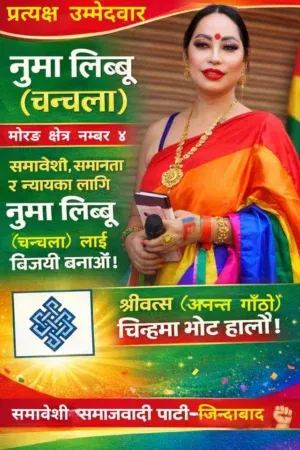
Eventually, under Pant’s mentorship and guidance, a new political force emerged after the Gen Z movement—the Inclusive Socialist Party. The party was formally registered with the Election Commission and is contesting the upcoming elections scheduled for Falgun 21 (March 4). The party has fielded 15 proportional representation candidates and six direct candidates across the country.
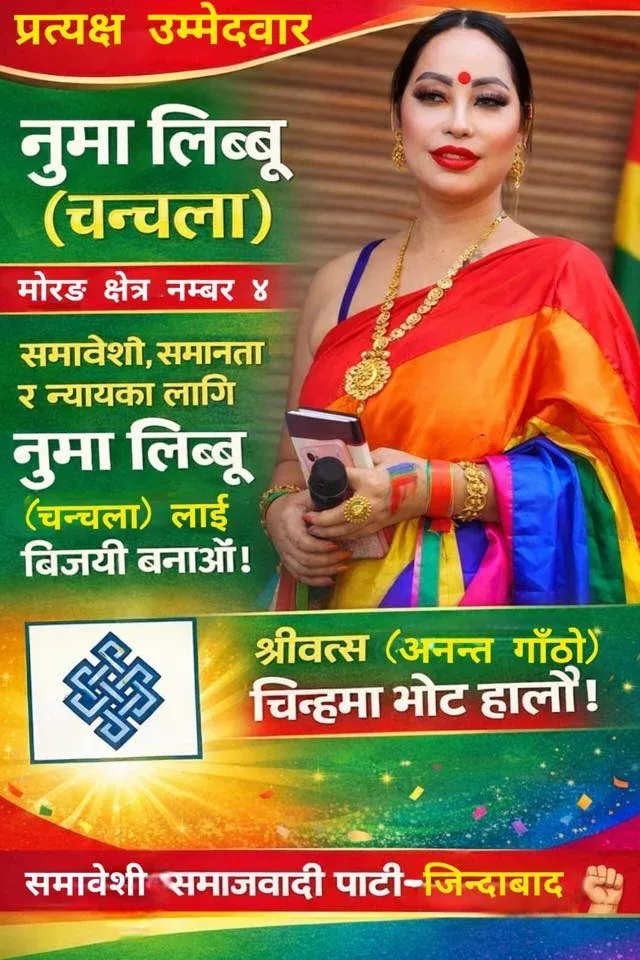
As a newly formed party with fresh faces in politics, the Inclusive Socialist Party faces the formidable challenge of competing against both established and emerging political forces. Among its candidates, Numa is contesting the direct election from Morang Constituency No. 4.
She is up against prominent political figures such as Nepali Congress General Secretary Guru Ghimire and former minister Aman Lal Modi, among others.
In total, 19 candidates are competing in Morang–4. Alongside Numa are candidates from major and minor parties, including Jeevan Ghimire (CPN-UML), Santosh Rajbanshi (Rastriya Swatantra Party), Madhav Prasad Acharya (Rastriya Prajatantra Party), Tavrej Akhtar Alam (JSP Nepal), Jeevan Kumar Gupta (Janamat Party), Krishna Kumar Atal (Shram Sanskriti Party), Hari Bahadur Basnet (CPN-Maoist), Ashok Sharma (Aam Janata Party), as well as candidates from 16 political parties and three independents.
Despite the intense competition, Numa remains undeterred. She is actively reaching out to voters through social media platforms. Morang–4 has 119,255 registered voters, and Numa has also appealed to rival political parties to support the six direct candidates from her party and help elect them unanimously.
Beyond Morang, the Inclusive Socialist Party has fielded other direct candidates: Pinky Rai from Okhaldhunga (Koshi Province), Devendra Bahadur Khatri (Madhu) from Rupandehi–2 (Lumbini Province), Binod Lama (Konika) from Kavrepalanchok–1, Surendra Pandey from Kathmandu–1, and Purnachandra Paudel from Kathmandu–10.
Out of Nepal’s 165 constituencies, Numa has formally requested political parties to extend support in six constituencies. She has already prepared a detailed list of development priorities for her constituency. Having personally experienced the bitter reality of elected representatives who make promises before elections and disappear afterward, Numa has chosen a different path.
She does not promise what cannot be delivered. Instead, she speaks only of achievable goals. Holding accountable those who exploit communities in the name of representation and eliminating corruption from the country are among her core political objectives. Armed with these issues, she has stepped confidently into the electoral arena.
The outcome will only be known after voting on Falgun 21, and Numa remains optimistic about a positive result. Yet, even if the day does not bring electoral victory, it will not break her spirit. A life marked by struggle and hardship has taught her resilience—because hope, she says, has always been her constant companion.