US-Iran Peace Deal Expected Friday as $300 Billion Private Investment Fund Proposed for Iran’s Reconstruction
GNN
Published on 7:58 am
29Shares
The United States and Iran are reportedly preparing to sign a formal peace agreement on Friday, marking a significant step toward ending months of conflict between the two nations. As part of the broader framework for post-war stabilization, negotiators have proposed the creation of a massive $300 billion private investment fund aimed at supporting Iran’s economic recovery and attracting long-term foreign investment.
According to sources cited by Reuters, the proposed fund has been incorporated into the preliminary understanding reached by American and Iranian officials and is intended to provide economic incentives for both sides to move toward a comprehensive peace settlement. Given the sensitivity of the ongoing negotiations and the anticipated signing ceremony, details of the plan have largely remained confidential.
Sources familiar with the discussions said that more than half of the proposed investment commitments have already been secured from private-sector participants. The initiative is not expected to function as government aid or war reparations. Instead, it would operate as an independent private investment mechanism designed to stimulate economic growth and rebuild key sectors of Iran’s economy.
Several major private companies from South Korea, Japan, Singapore, Malaysia, and the United States are understood to have expressed interest in participating in the fund. Investments would reportedly be directed toward strategic sectors including energy production, transportation networks, manufacturing industries, steel production, oil refineries, airports, and other critical infrastructure projects.
From Conflict to Negotiation
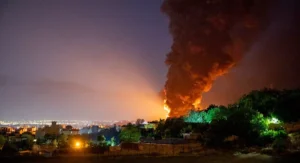
The conflict between the United States and Iran began on February 28 following joint military operations conducted by the United States and Israel against Iranian targets. After months of escalating tensions and military confrontations, officials from both countries reportedly reached a preliminary understanding on Sunday outlining a pathway toward ending hostilities.
Under the initial framework, the United States is expected to lift economic restrictions imposed on Iran, while the strategically important Strait of Hormuz—one of the world’s most critical maritime routes for global energy supplies—would be reopened to international shipping.
The reopening of the waterway is viewed as a potentially significant development for global energy markets, as a substantial share of the world’s oil and natural gas exports pass through the narrow channel connecting the Persian Gulf to international waters.
The Origins of the Reconstruction Fund
Iran had initially sought approximately $400 billion in compensation for damages resulting from the conflict. However, Washington reportedly rejected the idea of direct government-funded compensation, prompting negotiators to explore alternative mechanisms.
The proposed solution is a privately financed initiative tentatively known as the Reconstruction and Development Fund, which would mobilize capital through direct investments, loan guarantees, and financial facilities backed by regional and international partners.
Despite possessing some of the world’s largest energy reserves—including the second-largest natural gas reserves and the fourth-largest proven oil reserves—Iran has struggled to attract significant foreign investment for decades due to extensive international sanctions and economic restrictions.
Supporters of the initiative argue that Iran’s vast natural resources, strategic geographic position, and population of more than 92 million people provide substantial long-term economic potential. They believe that a large-scale investment programme could modernize infrastructure, create employment opportunities, and accelerate economic growth across multiple sectors.
Conditions Attached to the Agreement
The White House has indicated that Iran would be required to meet several conditions before gaining access to the proposed investment mechanism.
According to statements attributed to U.S. Vice President J.D. Vance, Iran would be expected to fully dismantle its nuclear weapons programme, eliminate stockpiles of highly enriched nuclear material, and accept a robust international inspection regime designed to verify compliance with future nuclear commitments.
Officials emphasized that the document expected to be signed on Friday is not a final peace treaty but rather a 60-day Memorandum of Understanding (MoU) establishing the framework for future negotiations.
During the 60-day period, negotiators from both countries are expected to conduct parallel discussions on nuclear issues, sanctions relief, regional security arrangements, and the structure of the proposed investment fund.
Administrators of the fund would also work alongside Iranian authorities and international investors to identify priority projects, determine investment allocations, and establish governance mechanisms. Full implementation of the fund is expected only after a comprehensive and binding peace agreement is finalized.
If successfully concluded, the agreement could represent one of the most significant diplomatic and economic breakthroughs in the Middle East in recent decades, potentially reshaping regional stability and opening a new chapter in relations between Washington and Tehran.