People Want a Woman Prime Minister in Nepal, but Bidhya Overshadows Renu
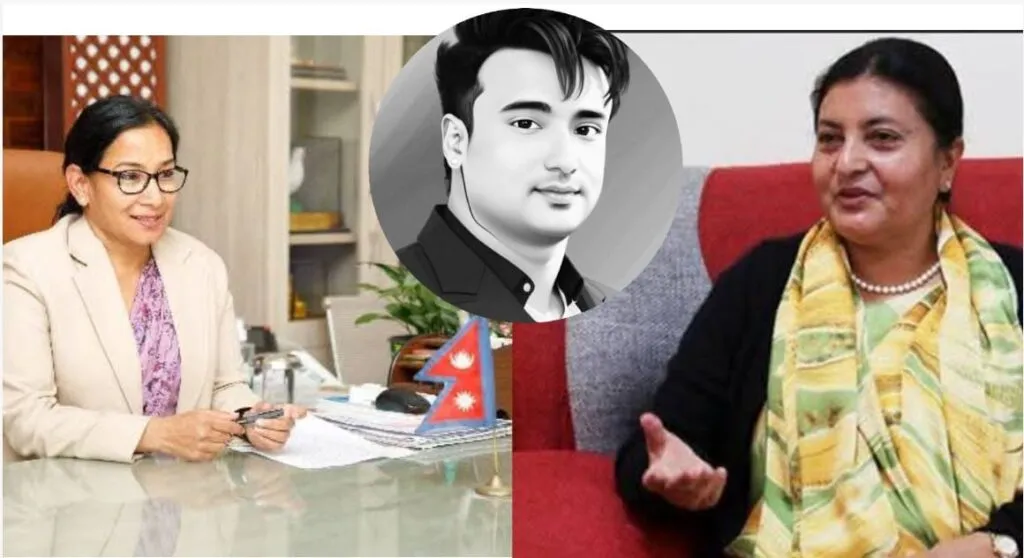

Although the people of Nepal have expressed a desire for a woman to lead the country as Prime Minister, the name of Renuka Dahal, once considered the sole potential candidate, now appears to be fading into the shadows.
Bidya Devi Bhandari, who has already completed two terms as the honorable President and is also the wife of late Madan Bhandari, has returned to active politics within the CPN-UML. Her reentry into politics has overshadowed the hopes surrounding Renuka as the country’s first female Prime Minister.
While Bidya’s political comeback is facing unease not only within UML but also among Nepali Congress leaders, other parties, including the Maoists, believe that if UML were to be led by Bidya, public resentment toward UML could diminish, and the possibility of a national unity government might strengthen.
However, citizens active on social media have voiced that they do not want either Bidya or Oli to lead the UML. The main reason cited is that even after serving two terms as President, Bidya never spoke up about the assassination of her husband, people’s leader Madan Bhandari. This silence, in the eyes of many, has eroded her credibility.
Social media user Durga Kshetri, in a detailed Facebook post, weighed in on the debate, presenting a comparative analysis of the two women:

A discourse on Nepal’s first female Prime Minister is now underway. At the heart of this debate are two key figures—former President Bidya Bhandari and Bharatpur Mayor Renuka Dahal. The spotlight has especially turned toward Bhandari due to her reemergence and potential political ambitions.
Previously, Renuka Dahal was seen as the sole contender for the role. However, Bhandari’s return has turned the race into a dual contest. Between the two, who can offer the nation long-term leadership benefits?
Bidya Bhandari is often portrayed as a puppet of third parties trying to capitalize on Madan Bhandari’s legacy following his assassination. Renuka Dahal, in contrast, is seen as a revolutionary fighter who joined the struggle for democracy from a young age.
Despite serving two terms as President, Bhandari showed no genuine concern or initiative regarding her husband’s murder. Instead, she is remembered for acting as KP Oli’s “yes-woman” during his tenure. Her support in his unconstitutional attempt to dissolve Parliament on the night of Poush 5 severely undermined the democratic constitution born from the blood of thousands of martyrs.
The Supreme Court eventually intervened and restored the Constitution, an act that stands in stark contrast to Bhandari’s controversial role. Even after the Court reversed her decision, no one questioned her ethics—and she herself never showed remorse.
Meanwhile, Renuka Dahal has been an active soldier in Nepal’s democratic movement since her youth. She has proven her mettle as a professional political leader. In the first local elections, she created political history by winning in Bharatpur, a longtime stronghold of Congress and UML. Her performance as Mayor was so impactful—especially in areas like roads, health, education, and urban infrastructure—that it silenced criticism about her involvement in a controversial ballot paper tearing incident.
What she achieved in Bharatpur is no small feat. Her development model, reminiscent of a practical, Nepali-adapted version of China’s progress, has now become a benchmark. Moved by Bharatpur’s transformation, even independent and Maoist-leaning voters across the country have joined the call for making Renuka Dahal the next Prime Minister.
In summary, Bidya Bhandari represents the archetype of an unwilling participant in the political drama of Nepal’s history, while Renuka Dahal symbolizes an empowered woman leader—one who fights on the ground, delivers development, and connects with the people directly.
Therefore, if Nepal genuinely seeks a people-oriented, experienced, and progressive woman leader as its first female Prime Minister—the clear choice is Renuka Dahal.