Three Decades of Struggle: Nepali Women’s Journey from Pain to State Power
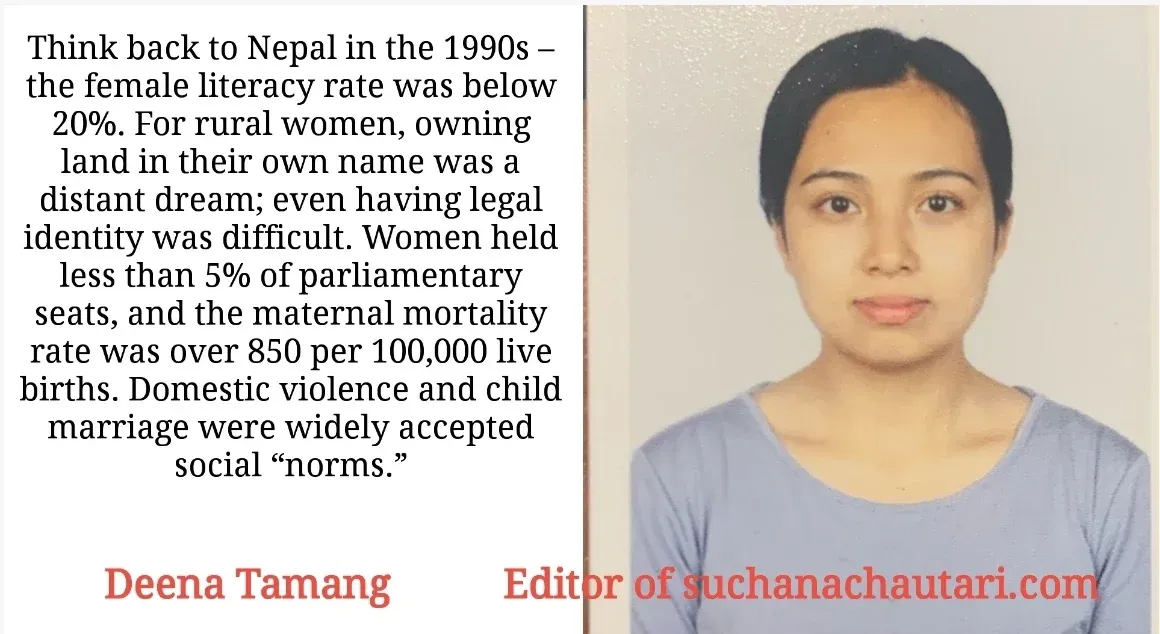

Deena Tamang, Kathmandu:
Three decades ago, the voices of Nepali women were confined within the kitchen and household walls. Their presence in education, healthcare, and politics was almost negligible. However, the democratic movement that began in 1990 (2046 BS) played a vital role in bringing women into public life.
Think back to Nepal in the 1990s – the female literacy rate was below 20%. For rural women, owning land in their own name was a distant dream; even having legal identity was difficult. Women held less than 5% of parliamentary seats, and the maternal mortality rate was over 850 per 100,000 live births. Domestic violence and child marriage were widely accepted social “norms.”
Anamika Rai, a 65-year-old from Khotang, recalls: “We didn’t even know about policies or rights. Even our names were written only after our husbands’. If you talked about educating daughters, society would laugh at you.”
The 2006/07 (2062/63 BS) People’s Movement opened a new chapter for women in state policies. The 2015 Constitution guaranteed a mandatory 33% representation for women from the federal to local levels. Today, more than 40% of leadership positions in Nepal’s 753 local governments are held by women. This can be seen both as an achievement of the republic and a result of women’s strong presence in the people’s movements.
Health has seen remarkable improvement. From over 850, the maternal mortality rate has dropped to 151, thanks to initiatives like the Female Community Health Volunteers program and the Safe Motherhood Policy, according to the Ministry of Health.
Education has also surged. By 2021 (2078 BS), the female literacy rate had risen to 68%, with an increasing number of women enrolled in universities.
This progress inspires young women like 23-year-old Sanjana Shrestha from Lalitpur: “The time of silencing women is over. We are moving ahead with dreams of leadership. But many sisters in rural areas are still trapped by old mindsets.”
However, deep inequalities persist between rural and urban women. Domestic violence, rape, and human trafficking remain pressing challenges. In Nepal’s western and far-western regions, traditional beliefs still keep the practice of chaupadi alive, where women are banished to sheds during menstruation, often at the cost of their lives. Cases of female exploitation in foreign employment are also rising.
While women’s cooperatives and microfinance programs have expanded economic access, decision-making power at policy levels is still largely dominated by men. The constitution ensures equal rights, but practically, much work remains for true empowerment.
Thus, the woman who carried the pain of three decades ago has now become a citizen with equal constitutional rights. She is carving out her place in education, politics, and the economy. But the journey is not yet complete. Only when policies and opportunities fully reach rural women can this change truly be called “empowerment.”
# Deena Tamang is the editor of suchanachautari.com