Questions Over Transparency and Accountability Intensify Within Nepal’s Christian Community

Kathmandu, Nepal — Questions surrounding financial transparency, institutional asset management, and leadership accountability within Nepal’s Christian community have resurfaced in recent weeks, triggering renewed public debate and discussion across social media platforms and community circles.
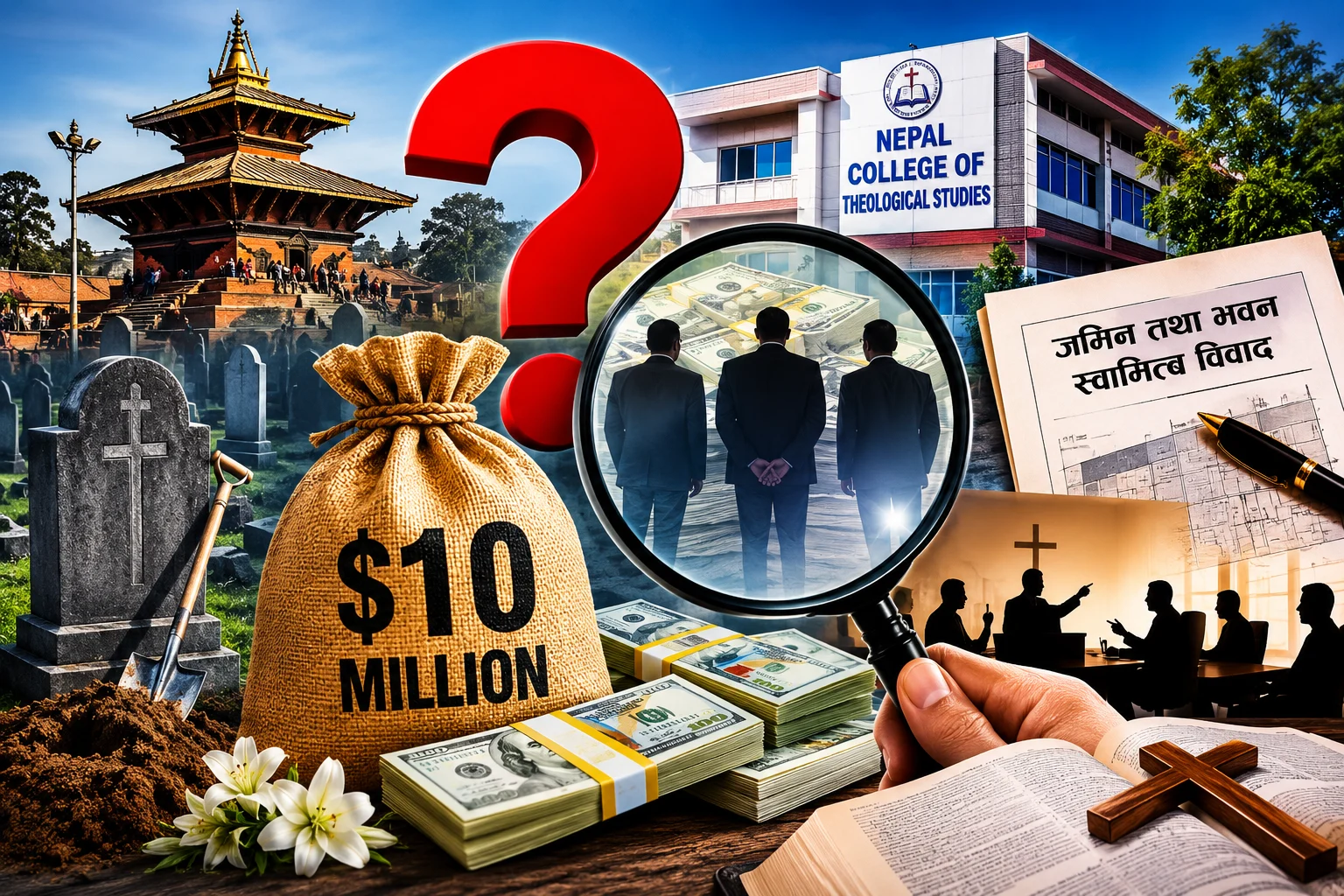
The latest controversy emerged after social activist Abhishek Joshi publicly called for disclosure of the financial records relating to a reported USD 1 million allegedly received in 2009 for the establishment of a Christian burial ground in Nepal. Through a series of social media posts, Joshi questioned how the funds, if indeed received, were utilized and why a fully developed burial facility has yet to materialize.
According to Joshi, the matter warrants public clarification from the concerned stakeholders. He argued that if such a substantial amount was genuinely secured for the stated purpose, the Christian community deserves a transparent account of how the funds were managed and expended. His remarks have generated both support and criticism, reflecting differing opinions within and beyond the Christian community.
The issue has also reignited broader discussions regarding financial accountability among religious and non-profit institutions. Some community members have called for greater transparency concerning donor contributions, foreign assistance, and institutional expenditures, arguing that openness is essential for maintaining public trust. Others, however, have emphasized that allegations should be substantiated by verifiable evidence before conclusions are drawn.
Adding to the ongoing debate are questions previously raised regarding the ownership, management, and transfer of land and buildings associated with the Nepal Academy of Science and Religion. Various individuals and groups have alleged that decisions concerning the institution’s assets lacked sufficient transparency and have called for an independent review of the processes involved.
Those associated with the institution, however, have maintained that all actions were undertaken in accordance with legal procedures and organizational decisions. Nevertheless, the dispute has continued to fuel discussion about governance standards, institutional stewardship, and accountability within faith-based organizations.
As concerns over both financial transparency and institutional property management gain attention, calls for stronger governance mechanisms have grown louder. Several church leaders and community stakeholders have advocated for open dialogue, public disclosure of relevant documentation, and impartial investigations where necessary. They argue that addressing legitimate concerns through facts and evidence is more constructive than dismissing or attacking those who raise questions.
Nepali journalist Dipesh Shrestha has also weighed in on the issue through social media, urging relevant organizations to provide clear and comprehensive responses to the concerns being raised. He stated that demands for transparency and accountability should not be viewed merely through the lens of internal factional disputes, but rather as matters affecting the long-term credibility and integrity of the wider Christian community.
Governance experts note that many controversies involving religious and non-profit organizations can be mitigated through proactive disclosure of financial records, donor-funded projects, institutional assets, and decision-making processes. A lack of transparency, they argue, often creates an environment in which speculation, mistrust, and public controversy can flourish.
While comprehensive official responses from the institutions and leaders concerned have yet to be made publicly available, the ongoing debate has underscored a growing demand for transparency, accountability, and good governance within Nepal’s religious institutions. Observers maintain that if the allegations are unfounded, they should be addressed through factual clarification; if shortcomings exist, they should be examined through fair and independent scrutiny. Ultimately, many believe that transparency remains essential to preserving public confidence and institutional credibility.
Suggested Headline Alternatives:
Transparency Under Scrutiny: Questions Mount Over Finances and Institutional Assets Within Nepal’s Christian Community Calls for Accountability Grow Amid Financial and Property Management Concerns Debate Intensifies Over Alleged USD 1 Million Fund and Institutional Asset Governance Public Demands Greater Transparency From Religious Institutions as Questions PersistKathmandu, Nepal — Questions surrounding financial transparency, institutional asset management, and leadership accountability within Nepal’s Christian community have resurfaced in recent weeks, triggering renewed public debate and discussion across social media platforms and community circles.
The latest controversy emerged after social activist Abhishek Joshi publicly called for disclosure of the financial records relating to a reported USD 1 million allegedly received in 2009 for the establishment of a Christian burial ground in Nepal. Through a series of social media posts, Joshi questioned how the funds, if indeed received, were utilized and why a fully developed burial facility has yet to materialize.
According to Joshi, the matter warrants public clarification from the concerned stakeholders. He argued that if such a substantial amount was genuinely secured for the stated purpose, the Christian community deserves a transparent account of how the funds were managed and expended. His remarks have generated both support and criticism, reflecting differing opinions within and beyond the Christian community.
The issue has also reignited broader discussions regarding financial accountability among religious and non-profit institutions. Some community members have called for greater transparency concerning donor contributions, foreign assistance, and institutional expenditures, arguing that openness is essential for maintaining public trust. Others, however, have emphasized that allegations should be substantiated by verifiable evidence before conclusions are drawn.
Adding to the ongoing debate are questions previously raised regarding the ownership, management, and transfer of land and buildings associated with the Nepal Academy of Science and Religion. Various individuals and groups have alleged that decisions concerning the institution’s assets lacked sufficient transparency and have called for an independent review of the processes involved.
Those associated with the institution, however, have maintained that all actions were undertaken in accordance with legal procedures and organizational decisions. Nevertheless, the dispute has continued to fuel discussion about governance standards, institutional stewardship, and accountability within faith-based organizations.
As concerns over both financial transparency and institutional property management gain attention, calls for stronger governance mechanisms have grown louder. Several church leaders and community stakeholders have advocated for open dialogue, public disclosure of relevant documentation, and impartial investigations where necessary. They argue that addressing legitimate concerns through facts and evidence is more constructive than dismissing or attacking those who raise questions.
Nepali journalist Dipesh Shrestha has also weighed in on the issue through social media, urging relevant organizations to provide clear and comprehensive responses to the concerns being raised. He stated that demands for transparency and accountability should not be viewed merely through the lens of internal factional disputes, but rather as matters affecting the long-term credibility and integrity of the wider Christian community.
Governance experts note that many controversies involving religious and non-profit organizations can be mitigated through proactive disclosure of financial records, donor-funded projects, institutional assets, and decision-making processes. A lack of transparency, they argue, often creates an environment in which speculation, mistrust, and public controversy can flourish.
While comprehensive official responses from the institutions and leaders concerned have yet to be made publicly available, the ongoing debate has underscored a growing demand for transparency, accountability, and good governance within Nepal’s religious institutions. Observers maintain that if the allegations are unfounded, they should be addressed through factual clarification; if shortcomings exist, they should be examined through fair and independent scrutiny. Ultimately, many believe that transparency remains essential to preserving public confidence and institutional credibility.