US Launches Fresh Airstrikes on Iran as Hormuz Tensions Escalate, Trump Warns of Further Strikes


Washington, D.C. — The United States has carried out a new wave of airstrikes against Iran, further escalating tensions in the Gulf region despite a recently signed ceasefire framework between the two countries. The strikes came hours after President Donald Trump warned that Washington would launch additional military action following what he described as Iranian attacks on commercial vessels in the Strait of Hormuz.
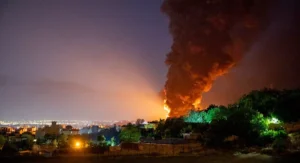
According to Iranian state media, multiple explosions were reported overnight in the southern port cities of Bandar Abbas and Sirik, both strategically located along the Strait of Hormuz, one of the world’s most critical maritime trade routes. Additional explosions were also reported in Konarak, Chabahar, Jask, and on Abu Musa Island, a disputed territory claimed by both Iran and the United Arab Emirates.
In a post on his social media platform, Truth Social, President Trump said the latest strikes were conducted in retaliation for Iran’s alleged attacks on vessels transiting the Strait of Hormuz. “This is in response to Iran’s bombing of ships in the Strait of Hormuz yesterday. If this happens again, the consequences will be far more severe,” Trump wrote.
The United States Central Command (CENTCOM) said the operation was aimed at further degrading Tehran’s ability to threaten freedom of navigation in the strategic waterway. In a statement, CENTCOM accused Iran of carrying out “unjustified aggressive actions” against commercial shipping and civilian crews operating in international waters and said the United States would continue to hold Tehran accountable for actions that threaten global maritime security.
Iran has not yet issued an official response to the latest strikes. However, senior Iranian officials had previously warned that any new military action by the United States would trigger an “immediate and decisive response.” Iranian state television reported that air defence systems were activated in Bandar Abbas during the attacks, while local media said electricity supplies were disrupted in Chabahar and that a facility belonging to the Islamic Revolutionary Guard Corps (IRGC) in Bushehr caught fire. Iranian authorities said two of the three damaged power transmission lines in Chabahar had already been restored.
Speaking to reporters aboard Air Force One on Wednesday evening, President Trump claimed that Iran had reached out seeking renewed negotiations. “They contacted us only a short while ago. They seem very eager to make a deal,” he said. “The real question is whether they are capable of honouring any agreement.”
The latest military exchange follows a sharp deterioration in relations despite the signing of a 14-point Memorandum of Understanding (MoU) on 17 June, which included a 60-day ceasefire, continued diplomatic negotiations, guarantees for safe passage through the Strait of Hormuz, and a commitment by the United States to consider easing sanctions on Iran. Although the ceasefire period has not yet expired, Trump declared that the agreement was effectively “over” after the recent attacks.
On Tuesday, the United States launched what it described as a “powerful” retaliatory strike following attacks on three oil tankers in the Strait of Hormuz. Iran subsequently claimed responsibility for missile attacks targeting US military facilities in Bahrain and Kuwait on Wednesday. The exchange is widely regarded as the most serious direct military confrontation between Washington and Tehran since the MoU was signed.
Trump also adopted an increasingly confrontational tone, saying he no longer wished to negotiate with Iran and describing its leadership in harsh terms. In response, Iranian Foreign Minister Abbas Araghchi wrote on X that Iran would respond “not with insults, but through action—with courage and determination.”
Although both sides had previously agreed to reduce tensions, recent attacks suggest that the ceasefire agreement is under severe strain. Earlier incidents, including missile strikes on a cargo vessel and an oil tanker in the Strait of Hormuz in late June, had already raised concerns that the fragile diplomatic understanding could unravel, fuelling fears of a broader regional conflict.
Editors’ Note: Several claims made by both the United States and Iran regarding the attacks, casualties, and military outcomes remain independently unverified. Official assessments from both governments are still emerging.