The Incident and the Central Legal Question
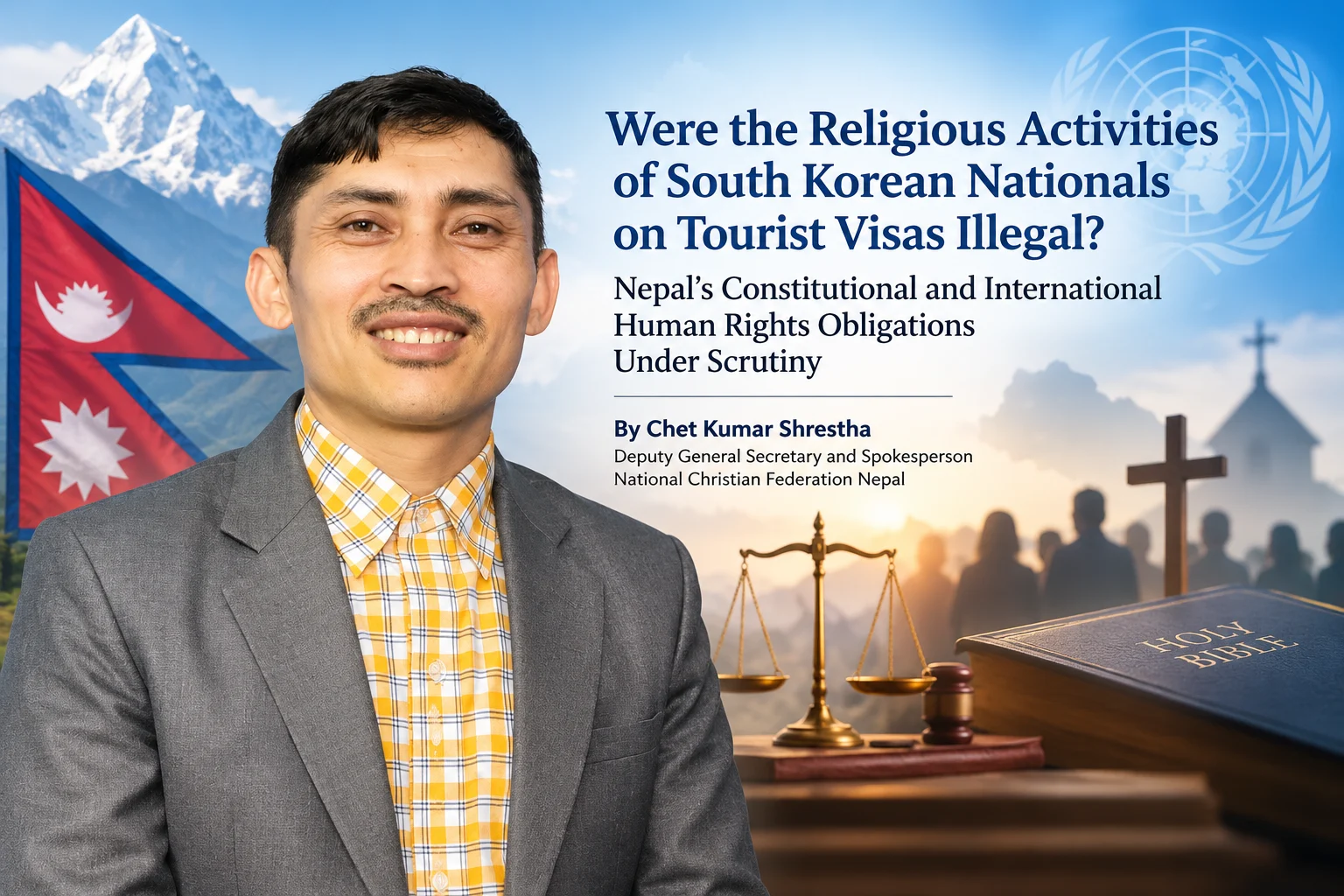

On 8 October 2026, 24 South Korean nationals were reportedly detained in connection with a Christian programme held at Nepal New Covenant College in Sundarharaicha Municipality–7, Morang District. According to media reports, the individuals were accused of engaging in religious education, training and activities associated with proselytisation while holding tourist visas. Subsequent reports stated that their visas were cancelled, each was fined NPR 50,000, and they were prohibited from re-entering Nepal for three years.
The precise activities undertaken by the individuals, the legal provisions applied and the grounds for the administrative decisions should, however, be verified against official records.
The central question is not whether these individuals were Christians or attended a Bible college. It is whether their actual conduct violated Nepali law and whether the State’s response complied with Nepal’s Constitution and its international human rights obligations.
A proper assessment must distinguish between peaceful worship, theological education, ministerial training, activities that may breach visa conditions and conduct specifically prohibited by law. These activities are not legally interchangeable, and their classification must depend on the facts and applicable legal provisions.
Article 18 of the ICCPR: Freedom of Religion or Belief Applies to Foreign Nationals
Nepal acceded to the International Covenant on Civil and Political Rights (ICCPR) on 14 May 1991 and is bound by its provisions.
Article 18(1) of the ICCPR protects freedom of thought, conscience and religion. It includes the freedom to have or adopt a religion or belief of one’s choice and to manifest that religion or belief, individually or in community with others, publicly or privately, through worship, observance, practice and teaching.
Article 18(2) prohibits coercion that would impair a person’s freedom to have or adopt a religion or belief of their choice. Article 18(3) permits restrictions on the manifestation of religion or belief only when they are prescribed by law and necessary to protect public safety, public order, public health or morals, or the fundamental rights and freedoms of others.
These protections are not limited to citizens. Foreign nationals within Nepal’s jurisdiction are also entitled to the applicable protections under the Covenant.
Nevertheless, freedom of religion does not exempt foreign visitors from valid immigration requirements. The relevant question is whether their activities fell within the scope of lawful religious expression or breached applicable visa conditions or other legitimate legal restrictions.
The authorities should therefore establish the nature of the activities and identify the specific legal grounds for any restrictions imposed. Neither nationality nor religious affiliation, by itself, establishes unlawful conduct.
Article 26 of Nepal’s Constitution: Religious Freedom and Its Constitutional Limits
Article 26(1) of the Constitution of Nepal guarantees every person who has faith in religion the freedom to profess, practise and protect their religion according to their conviction.
Article 26(2) recognises the rights of religious denominations to operate and protect their religious sites and religious trusts, subject to the Constitution and applicable law.
These provisions are relevant when assessing whether participation in a prayer meeting, a peaceful Christian gathering or a Bible study programme can, by itself, constitute an offence. Attendance at religious worship or study should not automatically be equated with unlawful proselytisation.
However, constitutional religious freedom is subject to the limitations set out in Article 26(3). This provision prohibits activities contrary to public health, decency and morality, activities that disturb public peace, and conduct involving the conversion of another person from one religion to another or otherwise jeopardising another person’s religion. Conduct falling within the constitutional prohibition is punishable in accordance with law.
The nature of the programme at Nepal New Covenant College must therefore be established. Was it a prayer meeting, theological instruction, ministerial training or an activity involving conduct prohibited by the Constitution or other applicable legislation?
These questions cannot be answered merely by identifying the venue as a Bible college or the participants as Christians. Equally, religious freedom cannot be treated as an automatic justification for conduct that is demonstrably unlawful.
The appropriate approach is an evidence-based assessment that respects both constitutional religious freedom and the restrictions established by law.
Tourist Visas and Religious Activities: A Necessary Legal Distinction
Nepal’s Immigration Act, 2049 (1992), together with the applicable Immigration Rules and other relevant provisions, regulates the entry and stay of foreign nationals.
Section 3 of the Act establishes the framework for entry and stay in Nepal under the applicable visa requirements, while Section 4 provides for conditions that foreign nationals must observe as prescribed.
The distinction between visiting a religious institution and undertaking activities that may require a different immigration status or authorisation is particularly important in this case.
A foreign national entering Nepal on a tourist visa may attend a religious gathering during a visit. However, if the person undertakes activities outside the purposes or conditions permitted by the visa, the authorities may have grounds to investigate a possible immigration violation.
The legal assessment must therefore address several questions. What activities did each individual undertake? Did those activities fall outside the conditions of the visa issued to them? Was a different visa category or specific authorisation required under the applicable rules? Which statutory or regulatory provision was allegedly violated?
Entering a Bible college, attending a Christian programme or participating in prayer does not, by itself, establish misuse of a tourist visa. The authorities should identify the relevant visa conditions and explain how the conduct of the individuals concerned allegedly breached them.
Conversely, the fact that an activity takes place within a religious institution does not automatically place it beyond the scope of immigration law.
The issue is not whether immigration regulations apply, but whether they were correctly interpreted and lawfully enforced in the circumstances of this case.
Section 158 of the National Penal Code: Allegations of Unlawful Religious Conversion
Section 158 of Nepal’s National Penal (Code) Act, 2017 (2074 BS), addresses unlawful religious conversion and related conduct. Its provisions concern the conversion of another person from one religion to another, attempts or encouragement to bring about such conversion, and religious proselytisation undertaken with the intention of converting another person or undermining their religion or belief, as specified by law.
Whether this provision applies depends on the actual conduct alleged and the legal elements of the relevant offence.
Religious instruction, Bible study, theological education and ministerial training are not necessarily equivalent to unlawful religious conversion. The relationship between a particular activity and the statutory prohibition must be assessed by examining the evidence and the precise wording of the law.
If the South Korean nationals engaged in conduct that satisfies the legal requirements of an offence under Section 158, the competent authorities may investigate and take action in accordance with the law.
However, an allegation of proselytisation does not, by itself, establish that an offence occurred. The conduct in question, the relevant intention where legally required, and the other elements of the alleged offence must be assessed on the available evidence.
This distinction is essential to protecting religious freedom. A prohibition against unlawful conversion should not be interpreted so broadly that peaceful religious education or worship is automatically treated as criminal conduct.
The authorities should therefore clarify the factual and legal grounds for any allegation under Section 158, subject to applicable legal and privacy requirements.
United Nations Human Rights Standards on Religious Teaching and Restrictions
The United Nations Human Rights Committee’s General Comment No. 22 (1993), which interprets Article 18 of the ICCPR, provides important guidance on the scope of freedom of religion or belief.
The Committee explains that the freedom to manifest religion or belief encompasses worship, observance, practice and teaching. It also recognises that religious communities may undertake activities integral to their basic affairs, including choosing religious leaders, priests and teachers, establishing seminaries or religious schools, and preparing and distributing religious texts.
These principles are relevant to theological education and ministerial training. Religious teaching is expressly recognised within the scope of Article 18, although the protection applicable to a particular activity must be assessed in light of the Covenant and the circumstances involved.
General Comment No. 22 also makes clear that restrictions on the manifestation of religion must satisfy the conditions set out in Article 18(3). They must be prescribed by law, pursue one of the permitted objectives and be necessary for that objective. Restrictions must not be imposed for discriminatory purposes or applied in a manner that undermines the protected right.
Accordingly, a restriction cannot be justified merely by asserting that an activity was religious in nature. The State must identify the relevant legal basis and legitimate objective and establish why the restriction was necessary in the circumstances.
Conversely, international human rights law does not grant foreign nationals immunity from generally applicable immigration regulations or other lawful requirements.
The appropriate question is whether the authorities applied those requirements consistently with Nepal’s obligations under the ICCPR, including the principles of legality, necessity, proportionality and non-discrimination.
Did the Nepalese Government Violate National or International Law?
Determining whether the State violated the law requires more than reviewing media reports or the penalties reportedly imposed. The relevant administrative decisions, statutory provisions, investigation records and procedural safeguards must be examined.
Article 18 of Nepal’s Constitution guarantees equality before the law and equal protection of the law. Article 26 protects freedom of religion, subject to the constitutional limitations discussed above.
At the international level, Article 2(1) of the ICCPR requires States Parties to respect and ensure the Covenant’s recognised rights to individuals within their territory and subject to their jurisdiction, without discrimination on the prohibited grounds. Article 26 separately guarantees equality before the law and equal and effective protection against discrimination, including discrimination based on religion.
These provisions raise an important question: were the South Korean nationals treated according to neutral and consistently applied legal standards, or did their Christian affiliation influence the action taken against them?
If genuinely comparable activities undertaken by people belonging to other religious communities were permitted while the individuals concerned were penalised because of their Christian affiliation, that would raise serious concerns about discrimination and unequal protection under the law.
However, different treatment does not automatically establish discrimination. The relevant activities, legal circumstances and treatment of genuinely comparable cases must be examined.
Similarly, if the authorities imposed restrictions without a sufficient legal basis, or if the measures were unnecessary or disproportionate to a legitimate objective, the State’s compliance with its constitutional and international obligations would require further scrutiny.
On the information available in public reporting, it would be premature to conclude definitively that the Nepalese Government violated the Constitution or the ICCPR. Equally, it would be inappropriate to assume that the authorities acted lawfully without examining the evidence and legal grounds supporting their decisions.
A credible legal assessment must remain open to the evidence, irrespective of the religious identity of those involved.
The Fine, Visa Cancellation and Three-Year Entry Ban: What Must Be Examined?
Reports indicate that each of the 24 South Korean nationals was fined NPR 50,000, had their visa cancelled and was prohibited from re-entering Nepal for three years.
These measures raise separate legal questions. Each must be assessed under the applicable immigration legislation, rules and administrative provisions rather than treated as automatically lawful simply because the authorities imposed them.
Section 10(4) of the Immigration Act provides for a fine of up to NPR 50,000 for certain acts committed in contravention of the Act or its Rules, subject to the provision’s terms. Section 9 addresses the expulsion of foreign nationals and restrictions on re-entry in specified circumstances. Section 11 provides for an appeal to the High Court within 35 days against punishment imposed under Section 10(4).
These provisions establish relevant legal mechanisms, but their existence does not, by itself, determine whether the particular decisions in this case were lawful.
First, the exact statutory or regulatory provision authorising each measure must be identified. The authorities should clarify whether the fine, visa cancellation and entry ban arose from the same alleged violation or from separate legal grounds.
Second, it is necessary to establish whether the applicable provisions authorised the specific penalties imposed in the circumstances. The existence of a general power to regulate immigration does not resolve every question concerning the legality of a particular sanction.
Third, the procedure followed must be examined. Were the individuals informed of the allegations and the legal grounds for the proposed action? Were they afforded the opportunity to respond as required by the applicable legal framework? Were the decisions properly recorded, and were the relevant review or appeal procedures available?
The precise procedural rights applicable will depend on the nature of the decision and the governing law. Nevertheless, transparency, lawful decision-making and access to available review mechanisms are important safeguards against arbitrary administrative action.
The proportionality of the measures also warrants examination. If a visa condition was breached, the authorities must still act within the powers conferred by law. The seriousness of the alleged violation, the applicable statutory framework and the reasons for the penalties are all relevant to assessing whether the decisions were justified.
Without the actual administrative orders and the provisions relied upon, the legality of the NPR 50,000 fines, visa cancellations and three-year entry bans cannot responsibly be determined conclusively.
A Call for Transparency, Equal Treatment and Respect for Religious Freedom
The National Christian Federation Nepal calls upon the Government of Nepal to clarify the legal basis for the action taken against the 24 South Korean nationals and to ensure that the constitutional and international protections afforded to freedom of religion or belief are respected.
The Government should make the relevant decisions and legal grounds available through appropriate official channels, subject to lawful confidentiality requirements. It should clarify the nature of the alleged violations, identify the provisions applied and explain the basis for the penalties imposed.
The authorities should also ensure that immigration regulations and laws concerning religious conversion are enforced consistently, without discrimination on the basis of religion or nationality.
Where evidence establishes a genuine violation of visa conditions or other applicable laws, lawful enforcement remains legitimate. However, where individuals have engaged only in peaceful worship or religious education, their activities should not be treated as unlawful without a sufficient legal basis.
The Federation further encourages religious minority organisations, human rights advocates and other concerned stakeholders to pursue evidence-based complaints through appropriate national and international mechanisms, including the National Human Rights Commission, the competent courts and, where the relevant criteria are met, the United Nations Special Rapporteur on freedom of religion or belief.
Any submission should be supported by verifiable evidence, relevant administrative documents and a clear explanation of the alleged legal violations. This approach would help ensure that concerns about religious freedom are assessed on their merits rather than through speculation or unsubstantiated allegations.
Conclusion: The Rule of Law Must Protect Everyone Equally
The participation of foreign nationals in prayer or peaceful religious worship at a Bible college does not, by itself, establish that they violated Nepali law. Equally, religious freedom does not exempt foreign visitors from valid visa conditions or generally applicable legal requirements.
The decisive questions are what the individuals actually did, which legal provisions applied, what evidence supported the allegations, and whether the authorities’ response was lawful, necessary, proportionate and non-discriminatory.
Nepal’s constitutional commitment to religious freedom and its obligations under international human rights law require the State to protect the rights of all persons within its jurisdiction while enforcing legitimate laws fairly and consistently.
The demand for transparency and accountability is not a demand to place any religious community above the law. It is a call to ensure that the law applies equally to everyone, that peaceful religious practice is protected, and that no individual or community is subjected to discrimination because of their religion or belief.
Chet Kumar Shrestha
Deputy General Secretary and Spokesperson
Federation of National Christian Nepal