Who Was Mahaguru Falgunanda?
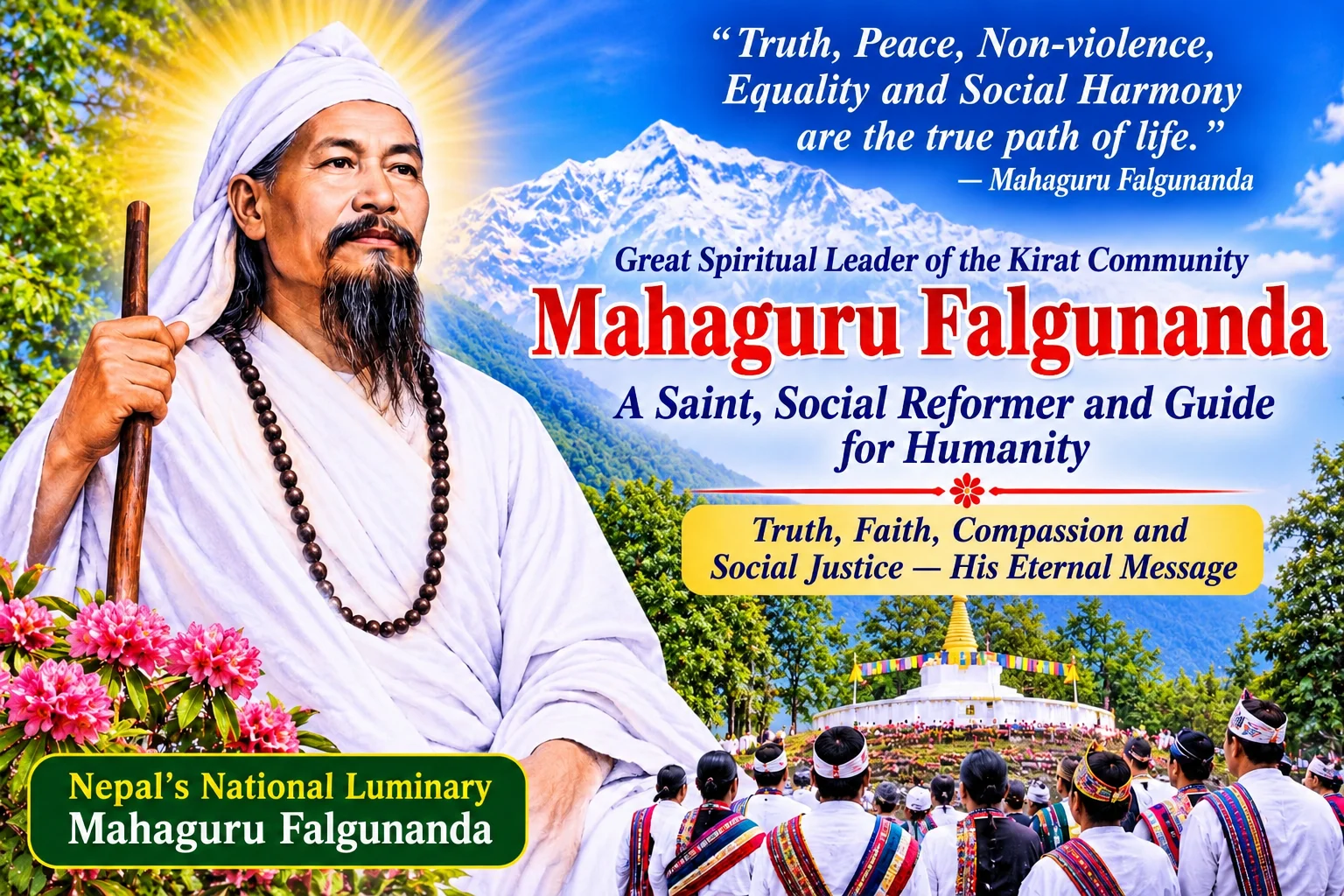

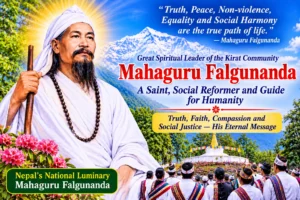
GNN | Kathmandu, Nepal – Mahaguru Falgunanda Lingden holds a distinguished place in Nepal’s religious, cultural and social history. He was not merely a religious leader but also a spiritual thinker, social reformer, advocate of non-violence and an influential figure in preserving the identity, traditions and cultural heritage of the Kirat community. He is particularly revered among the Limbu people of eastern Nepal, who regard him as one of their greatest spiritual teachers. His contributions to the preservation of Kirat philosophy, Mundhum traditions, indigenous language, script and cultural practices, alongside his campaigns against harmful social customs, have established his legacy as an important figure in Nepal’s history. In recognition of his contributions, the Government of Nepal declared him a National Luminary on 16 Mangsir 2066 B.S.
Birth and Historical Background :
Mahaguru Falgunanda Lingden was born on 25 Kartik 1942 B.S. (approximately November 1885) in Chukchinamba, in present-day Mangsebung area of Ilam District, eastern Nepal. His birth name was Naradhwaj Lingden, according to various biographical accounts. He was born into an ordinary family belonging to the Lingden lineage of the Limbu community. From an early age, he demonstrated an interest in spirituality, religious values and social life. During his youth, he reportedly served in the military, gaining experience of the hardships and consequences of armed conflict. Historical accounts suggest that his experiences during the First World War influenced his understanding of violence, human suffering and the importance of peace. He subsequently abandoned military life and devoted himself to spiritual practice, meditation and social reform. His lifetime is generally recorded as 1885–1949 AD.
Why Is Falgunanda Revered as Mahaguru?
Falgunanda is revered as Mahaguru primarily because he brought together spiritual awareness, religious philosophy and social transformation. During his lifetime, various harmful social practices were prevalent in society, including excessive alcohol consumption, animal sacrifice, extravagant ceremonies and financial exploitation associated with marriage customs. He actively campaigned against these practices and encouraged people to embrace truthfulness, non-violence, moral discipline, pure conduct and responsible living. He believed that religion should not be confined to rituals, ceremonies or traditional worship. Instead, he viewed it as a means of building an ethical, peaceful, disciplined and equitable society. His teachings sought to promote humanity, mutual respect and social responsibility. These principles earned him recognition not only as a spiritual guide but also as a transformative social reformer within the Kirat community.
The Seven-Point Satya Dharma Muchulka and Social Reform :
One of the most significant milestones in Mahaguru Falgunanda’s life was the adoption of the Satya Dharma Muchulka (Declaration of True Religion) at Labrekuti in Panchthar District in 1988 B.S. He brought together community leaders and representatives from the historical Dash Limbuwan Satra Thum region to discuss and address prevailing social and religious problems. The resulting seven-point declaration became an important foundation for social and religious reform within the Kirat community. Its principles encouraged people to abandon animal sacrifice and unnecessary violence, avoid alcohol consumption, eliminate dowry and excessive financial transactions in marriage, promote equal rights and educational opportunities for sons and daughters, simplify birth-to-death rituals, and preserve indigenous language, religion and cultural traditions. Different historical accounts and subsequent interpretations sometimes present variations in the number and wording of the principles. Therefore, the original seven-point declaration should be distinguished from its later expanded explanations. Nevertheless, the initiative remains an important chapter in the history of social reform among the Kirat people.
Contributions to the Preservation of Kirat Religion, Mundhum and Indigenous Language :
Another major contribution of Falgunanda was his commitment to protecting the religious and cultural identity of the Kirat community. He placed considerable importance on Mundhum, the traditional body of spiritual knowledge, philosophy, oral history, rituals and cultural teachings that forms an essential foundation of Kirat religious life. He encouraged the preservation and use of the historical Sirijanga script, the promotion of the Limbu mother tongue and the transmission of indigenous religious knowledge to younger generations. He also contributed to the establishment and development of Manghims, or Kirat religious centres, and encouraged the expansion of religious and spiritual activities. Chukchinamba in Ilam, Labrekuti and Silauti in Panchthar are among the historically significant places associated with his spiritual journey and religious movement. Through these initiatives, he helped strengthen cultural awareness and pride in the community’s indigenous identity, language, religion and heritage.
Which Communities Regard Him as a Spiritual Teacher?
Mahaguru Falgunanda is primarily revered by the Limbu community, which belongs to the broader Kirat ethnic group of Nepal. He is particularly respected in eastern districts such as Panchthar, Taplejung, Ilam, Tehrathum, Jhapa, Dhankuta, Morang and Sunsari. Followers of the Satya Hangma religious tradition regard him as a supreme spiritual teacher and an important guide to religious and moral life. Over time, his teachings and religious influence have also reached certain sections of other Kirat communities, including Rai, Yakkha and Sunuwar groups. However, it would be historically inaccurate to suggest that every Kirat community follows the same religious tradition or regards Falgunanda in exactly the same way. The Kirat population encompasses diverse religious beliefs, cultural practices and spiritual traditions. His religious legacy is therefore most accurately understood in the context of the Limbu community and the Satya Hangma tradition, while recognising its wider cultural influence.
National Recognition and Historical Significance :
The contributions of Mahaguru Falgunanda extend beyond the boundaries of any particular ethnic or religious community. His commitment to social reform, non-violence, moral values, equality, religious harmony and cultural preservation has given his legacy national significance. Recognising his historical contributions, the Government of Nepal officially declared him a National Luminary on 16 Mangsir 2066 B.S. Earlier, in 2050 B.S., Nepal Post had also issued a commemorative postage stamp in his honour. His birth anniversary is observed annually on 25 Kartik, with religious ceremonies, public gatherings, cultural programmes, peace rallies and awareness campaigns, particularly across eastern Nepal. These commemorations have helped introduce his philosophy and contributions to a wider national audience while strengthening recognition of Kirat religious and cultural heritage.
The Contemporary Relevance of Mahaguru Falgunanda’s Philosophy :
The teachings and philosophy of Mahaguru Falgunanda remain relevant to contemporary Nepali society. At a time when communities continue to face challenges such as caste-based discrimination, gender inequality, harmful social practices, violence, substance abuse, religious intolerance and threats to cultural identity, his emphasis on truth, non-violence, equality, moral responsibility and social harmony offers valuable guidance. His reformist vision suggests that religion should serve humanity and contribute to positive social transformation rather than become a source of division or discrimination. These principles are particularly significant for Nepal, a country characterised by religious, ethnic, linguistic and cultural diversity. At the same time, a balanced understanding of his life and contributions requires distinguishing documented historical evidence, academic research, religious beliefs and oral traditions passed down through generations. Ultimately, Mahaguru Falgunanda Lingden was not only a revered spiritual leader of the Kirat religion and the Limbu community but also an influential historical personality whose message of truth, peace, non-violence, equality and social reform carries significance for the entire nation. Honouring his legacy is also a way of respecting Nepal’s religious diversity, indigenous cultural heritage and the shared values of peaceful coexistence.